
The True Price of Financial Procrastination

Financial mistakes do not always come from making the wrong decision. Sometimes they come from putting off the right decision for another month, another year, or another decade. In this episode of The Roy Matlock Jr. Money and Business Hour, Roy turns the conversation around. Instead of explaining what you should do, he looks at what can happen when you don’t do it.
From failing to create a budget or emergency fund to delaying investing, carrying unnecessary debt, ignoring insurance needs, or trying to time the market, Roy explores how seemingly small decisions—or indecision—can create much bigger consequences over time.
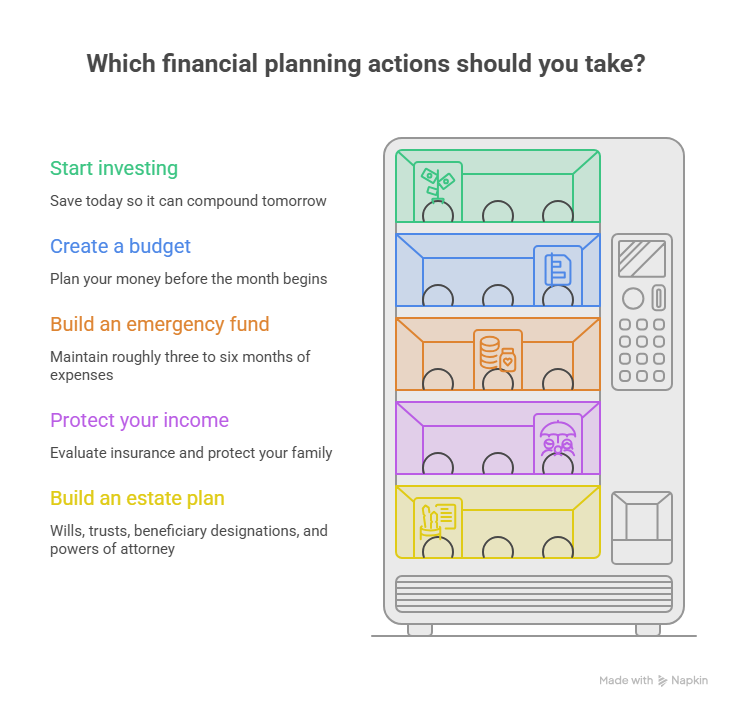
Which financial planning actions should you take?
What Is Financial Procrastination Really Costing You?
Roy’s central message is straightforward: what you do not save today does not have the opportunity to compound tomorrow.
It is easy to tell yourself that you will start saving next year. Increase your retirement contribution after the next raise. Build an emergency fund when things calm down. Finally review your financial plan when you have more time.
The problem is that time itself is one of the most valuable components of a financial strategy. Once those years are gone, they cannot be added back later. You cannot go back and invest money that should have been invested a decade ago.
The Cost of Waiting — A Concrete Example
Roy illustrates the difference time can make by comparing someone who begins investing $500 per month today with someone who waits ten years to begin. Using a hypothetical 10% annual return for illustration, the gap becomes increasingly dramatic over several decades.
The person who starts today and invests $500 per month for 30 years accumulates wealth over three decades. The person who waits ten years to start has only 20 years to invest that same $500 per month. The difference is not just the extra ten years of contributions. It is all the compounding that happened on those earlier deposits.
The lesson is not that any particular return is guaranteed. The lesson is that time is an asset. Repeatedly postponing an investment strategy creates an opportunity cost that becomes much more noticeable later in life.
The Budget — Your First Financial Defense
Roy begins with two foundational pieces of a financial plan: a spending plan (budget) and an emergency fund.
Many people view a budget as restrictive. Something limiting. Something to avoid. But Roy sees it differently. A budget is not about restriction. It is a plan for your money before the month begins. It allows you to prepare for expenses that may not happen every month. Car repairs. Home maintenance. Insurance costs. Other expenses that eventually show up.
Without a budget, you are reacting to expenses as they appear. With a budget, you are planning for them. That difference creates control. It creates the ability to manage your money instead of letting your money manage you.
The Emergency Fund — Your Second Line of Defense
An emergency fund adds another layer of protection. Roy generally recommends maintaining roughly three to six months of expenses in liquid reserves.
Without that cushion, an unexpected event can quickly lead to credit card debt, retirement plan withdrawals, penalties, taxes, or selling investments at an unfavorable time. Each of those has its own cost. The emergency fund prevents all of them.
Yet how many people have an emergency fund? A small percentage. Most people keep telling themselves they will build one when things settle down. Meanwhile, they are one car repair or medical bill away from serious financial trouble.
Protecting Your Income — The Most Valuable Asset
Roy emphasizes that your income is the foundation of your financial life. If a family depends on that income, protecting it should be a priority.
That can include evaluating life insurance, disability insurance, home and auto liability limits, umbrella coverage, and making sure your family would be protected if something unexpected happened to you.
Many people skip this. They think insurance is a waste of money. But the cost of not having it can be catastrophic. If you die and your family loses your income, what happens? If you become disabled and cannot work, what happens? If someone sues you, what happens? These are not pleasant questions to think about. But they are critical questions to answer while you still can.
Building Your Estate Plan — Protecting Your Family
Roy also discusses wills, trusts, beneficiary designations, and powers of attorney. Many people put this off indefinitely.
But estate planning is not something you do when you are old. It is something you do now, at any age. If something happens to you, your family should not face financial and legal complications on top of their grief. That is what estate planning prevents.
Defense First — Then Offense
Roy often describes financial planning in terms of defense and offense. Defense is about protecting the income and assets you have already worked to build. Offense is about building wealth over time.
Many people want to jump straight to offense. They want to invest. They want to build wealth. But without defense in place, one emergency wipes out years of progress. Do the defense first. Then invest for offense.
The Offense — Investing and Building Wealth
Once the defensive foundation is in place, Roy shifts to offense. One mistake he frequently sees is keeping too much long-term money sitting in cash.
While cash makes sense for checking accounts and emergency reserves, inflation can gradually reduce purchasing power when money intended for long-term goals never gets the opportunity to grow.
Another common mistake is attempting to time the market. Investors sell after markets fall. They wait for things to feel safe again. They struggle with when to get back in. Instead, Roy emphasizes building an investment strategy around your goals, risk tolerance, and most importantly, your time horizon.
Someone who may need money soon will approach risk differently from someone who is decades away from retirement. The goal is to create an allocation that fits the plan rather than continually reacting to headlines.
Diversification and Rebalancing Matter
Roy also discusses the importance of diversification and periodically rebalancing a portfolio. Over time, certain investments or asset classes may grow faster than others, changing the risk characteristics of the portfolio.
Without reviewing and rebalancing the strategy, the portfolio you own today may eventually look very different from the one you originally intended to own. That is how people who think they are conservative end up with portfolios that are more aggressive than they realize.
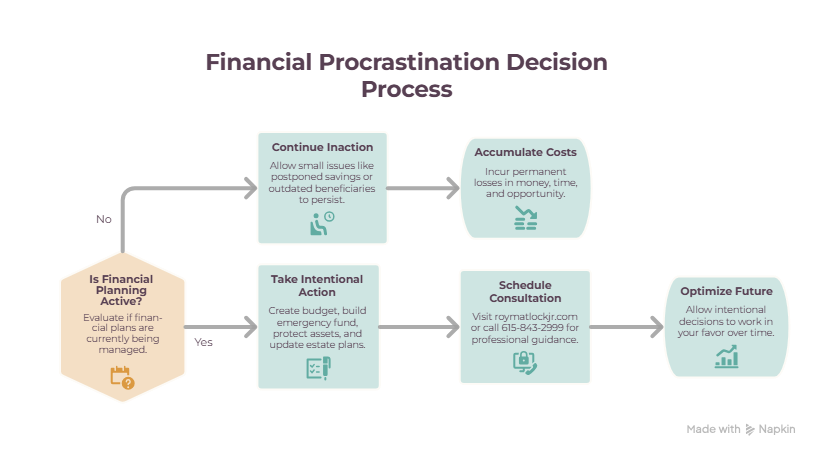
Financial Procrastination Decision Process
Doing Nothing Is Still a Decision
Roy’s central message is that doing nothing is still a financial decision. And it is almost never the best one.
Financial plans rarely fall apart because of one single bad decision. More often, small issues are allowed to continue for years. Saving gets postponed. Insurance does not get reviewed. Investments are not rebalanced. Beneficiaries remain outdated. Long-term goals never become part of an actual strategy.
Each of these decisions made consciously today would have been the right thing to do. But by putting them off, the cost accumulates. Not just in dollars, but in opportunities lost, peace of mind foregone, and risks taken without protection.
The Price of Procrastination
The cost of financial procrastination is real. It is measured not just in money, but in time. And since time cannot be recovered, the cost is permanent.
Start today. Create a budget. Build an emergency fund. Protect your income and assets. Get your estate planning documents in place. Then begin investing for your future.
The sooner you begin making intentional decisions with your money, the more time you give those decisions to work in your favor.
Ready to Stop Procrastinating?
If you have been putting off your financial plan, now is the time to act. Visit roymatlockjr.com or call 615-843-2999 to schedule a consultation. Roy and his team can help you identify where you are today and determine what needs to happen next.
Listen to the Full Podcast
This episode walks through the financial consequences of waiting—and why taking action today can make such a meaningful difference over time. Listen to the full September 19, 2026 episode of The Roy Matlock Jr. Money and Business Hour here: PODCAST: September 19, 2026
Watch the full video on YouTube: The Cost of Doing Nothing With Your Money
Business Owners on the Air with Roy
Are you a successful small business owner, or maybe you know someone who is! Roy wants to interview business owners who have success stories for inspiration to our listening audience, to share their journey from starting out to success. Nominate someone you may know, or yourself, by clicking here.
