
Building Financial Independence and Time Freedom


Roy Matlock Jr. is 65 years old. People ask him all the time when he is going to retire. His answer never changes: never. Why would he retire when he has time freedom, financial independence, and he loves what he does?
In this episode of The Roy Matlock Jr. Money and Business Hour, Roy shares something different. This is not just about budgets, investments, and retirement accounts. This is Roy’s personal story — how he built financial independence and time freedom from the ground up, and the exact blueprint anyone can follow to do the same.
You Have One of Two Problems — Income or Outgo
Roy has always said that if you have a money problem, you have one of two problems: an income problem or an outgo problem. That is it. Everything comes down to those two things.
If you are not making enough money, you have an income problem. If you are making plenty of money but spending all of it, you have an outgo problem. Sometimes you have both. The good news is you can fix either one, and it takes a lot less time to fix it than it took to create it.
Roy’s show today is about how he built financial independence and time freedom — and time freedom is what you are really shooting for. Time freedom means you have enough passive income that your time and your money are not tied together. You get up in the morning and do whatever you want because your investments are making money while you sleep.
The Recipe for Success — Put in the Right Ingredients
Roy believes in recipes. If you want a chocolate cake, you buy a chocolate cake mix. You do not try to talk the white cake mix into being a chocolate cake. It does not work that way.
You put ingredients into things, and you get outcomes. If you put in the wrong ingredients, you get the wrong outcomes. If you put in the right ingredients, you get the right outcomes. That is how success works.
So what are the right ingredients for financial independence? Roy breaks it down into a five or six step plan that he has used for 40 years to build wealth and freedom.
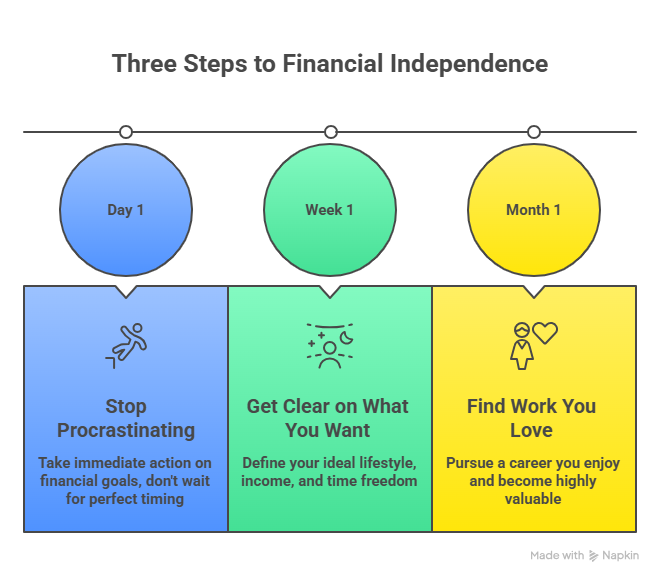
Three Steps to Financial Independence
Step One — Stop Procrastinating and Take Action
The number one enemy of financial independence is procrastination. People have great intentions and poor follow-through. They think about doing something, but they never actually do it.
Roy has watched thousands of people over 40 years. The ones who make it happen in a big way all have one thing in common: they take action. They do not wait for the timing to be right. They do not wait until they understand everything. They act on ideas immediately and adjust as they go.
If you have an idea, implement it. If it does not work out immediately, take the feedback and adjust. But do not wait. It is always going to be some reason to do it tomorrow, next week, next month. Before you know it, it is next year or 10 years from now, and you are talking about how you had a chance to buy that property on the corner 20 years ago.
Roy shares a COVID story. When COVID hit, he saw an opportunity. He immediately went all-in on Zoom. He sent emails to his entire client base teaching them how to use it. Then he hosted a webinar on fixing finances in 2020, and 1,600 people showed up. He thought, “This is just like the early days on the radio with Dave Ramsey when we reached 30,000 people every 15 minutes.” He expanded his business nationwide overnight because he took action.
Then he went on an appointment with a client who had just received $1 million from the Employee Retention Credit — a government program for businesses hurt by COVID. The client told Roy he had referred friends to the same program and earned referral fees. Roy asked how it worked. Within 30 days, Roy had a company set up helping businesses claim those credits. They ended up processing about $80 million in credits for businesses.
Roy tells another story. He was sitting at Brick Tops restaurant, and the person next to him mentioned their business. Roy helped them get $200,000 in credits. They were thrilled. That is what happens when you take action. Opportunities are in front of you all the time. If you do not act, nothing happens.
Step Two — Get Clear on What You Want
Most people fail not because they do not know what to do. They fail because they never clearly decide what they want. They do not have a clear vision of the outcome.
Roy grew up playing golf. In high school, he went out with a girl whose dad was in the insurance and investment business. What motivated Roy? The dad played a lot of golf and took customers out on the golf course. Roy thought, “Maybe this is something I need to do.” He looked around and found someone whose life looked like what he wanted. That gave him a vision.
If you are young and getting started, Roy says your goal should be this: by the time you are 30, you are doing exactly what you want to be doing. That is it. Do not quit jobs without having the next thing lined up. Just move from one to the next until you find what you love.
If you are older — maybe 40 and you hate your life right now — you are just behind a little bit. Figure out what you want. If everything worked out perfectly, what does it look like? What time do you get up? Where do you work? When do you work? How often do you work?
Roy works Monday, Tuesday, Wednesday. That has always been his goal. He wants to get everything done in the first two weeks of the month. He wants every hour to be valuable. He does not mess around. He delegates what other people can do. He uses AI and technology to get 20 extra hours per day of productivity.
What is your time freedom? How much income do you need each month to live the way you want? Maybe it is $10,000 per month. That is your monthly number. What is your financial independence number? That is the amount of money you need to generate that income.
Where do you want to live? What do you want to do? Family, golf, travel — what does your perfect week look like? Write it down. Roy has always wanted his freedom to be Thursday through Sunday. Get it all done early in the week. Sometimes it does not work out that way, but a large percentage of the time it does because he manages his outcome.
So step two: find out what you want. If you get up every morning dreading what you are doing, you are never going to make any money because you are not going to be good at it. Are you stressed? Do you want out of stress? What is causing it? Is it your bills? Is it an income problem or are you making bad choices with your money?
Step Three — Find Work You Love and Become Valuable
Your perfect world is always going to require income. If you do not have a decent amount of income, your life is not going to be great. Roy does not care how you slice it — if you have plenty of money with income greater than your expenses and a decent lifestyle, you will be much happier than if you are in the hole all the time.
So how does income get created? Roy finds it funny when people sit down with him and they really do not understand how income works. They say, “They should pay me more.” Roy asks why. They say, “Well, I am a good person.” Okay. There are a lot of good people out there. “Well, I show up every day.” Okay. That is a start.
But the reason your income increases is because your value increases. If you are in the marketplace right now, Roy has done this forever with employees. About six months in, he asks himself, “Knowing what I know now, would I rehire that person?” If yes, they are bringing value. Would he be concerned if they left? Would it damage his business? Then he wants to make sure they get treated right. Some employees damage the business if they stay. Those have to go.
It is called value proposition. What is your value proposition? One of the keys to becoming successful in anything you do is you have to love it. You have to love what you do.
People ask Roy when he is going to retire. He says never. Why would he? He has a great life. He has time. He makes money. He likes what he does. Roy truly believes that everything he does has been payment based on good outcomes for the people he works with. The clients get good outcomes, the advisors who work with him get good outcomes, and Roy gets paid for it. The more money he makes is in direct proportion to the number of people he has given good outcomes for.
So find something you like. Get good at it. Really good at it. Become an expert. You are not going to be an expert overnight. You are going to like it enough to stick with it even when it is not good. You get really good.
Then ask yourself: based on my lifestyle goals, my money goals, and my stress tolerance, am I in something that could one day allow me to reach all of those goals?
Your income and your ability to move forward are in direct proportion to how good you are at what you do. And how good you are has everything to do with whether you like what you do.
Roy gives examples. He does not like doing paperwork. If his job was paperwork, he would never be any good at it. He cannot even type. The only thing that saved him was when he could talk to his phone. He types about two words per minute. His mindset is that is not where he is going to focus. He is going to have someone way better at that than him to support him in the areas where he does not have the skillset.
What Roy’s Business Does — Two Models
Roy runs two parts of his business. The first is helping people get their finances in order. That involves everything from creating plans to investment management, insurance, wills and trusts, budgets — everything from the foundational part all the way up. If you want help with that, Roy’s team is a fiduciary. Visit roymatlockjr.com or call 615-843-2999.
Over a lifetime, Roy has helped about 40,000-plus people become clients. He meets with them, starts with a phone call, helps them get their plan of action in place, and calculates their financial independence number. One of Roy’s number one pieces of advice is pay yourself first and automate the outcome. They calculate the financial independence number, set a realistic timetable, determine a monthly investment amount, and automate it out of checking accounts or payroll. That is the starting point.
They have a defense to keep people from making mistakes and protect income and assets. They have an offense focused on growth and tax planning. That is what they do.
The other thing Roy does is help people who want to get out of dead-end jobs and build something they can feel good about. He brings in referral partners and trains people to become financial advisors. Over the years, a lot of people have come in and made new careers. The worst outcome they got was learning finance from the inside of a financial advisory firm. If you are interested, reach out to roymatlockjr.com.
Roy’s Business Model — From Self-Employed to Business Owner
Here is Roy’s business model. Number one: he found something he liked. Number two: he got really good at it. Number three: he became self-employed, which gave him control of his time. Number four: he built a business around that and expanded it with hundreds of advisors and people working with him. That gave him an ongoing business that does not require him to wake up every day for it to make money.
Roy does not care what business you are in. Your mindset could be: I love fitness. I am going to get my certifications and become a trainer. I am going to be great. I am going to build a following. Once I have a following, I am going to open a gym. Once I open the gym, I am going to maintain that quality and duplicate myself with other trainers. Now I have a business. Then I am going to find other people inside that business who want to open their own locations. Now I have a franchise.
That is how it all works. Every time you move from one step to the next, you get more freedom. You get more money. You get more freedom. If you do it right, you have something that will last long after you die. It does not require you to wake up every day for things to happen.
That is how you bring in the offense. A lot of people are playing defense. Do not play defense. You have to have an offense in place.
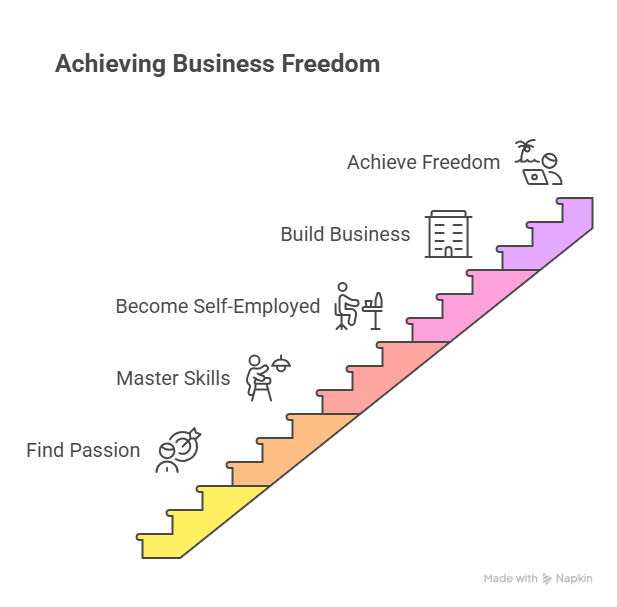
Achieving Business Freedom
Top Earners Are Top Performers
If you want to be highly paid, which will allow you to have a gap between income and expenses, you need to understand this: top earners are top performers. They provide more value. They are more consistent over time. And most people quit before they get good.
Roy sees it all the time in his industry. People come in and make it six months, then they are gone. Then he has people who come in and make millions of dollars doing the exact same thing in the exact same industry.
What is the difference? One of them maybe did not like it that much. The other one did. When tough times came along and they did not know what they were doing, they had to operate in the discomfort zone. One quit. The other one continued.
Then one day they wake up and realize they have been trying every day to get smarter, better, provide more service, get more value. They have been doing it 365 days a year. Now they have been doing it five years. They have thousands of hours in. There are very few things they do not know the answer to. Over time, they start seeing their income go up.
The difference is skill and work put together.
So do not be stuck in situations that have no good outcome for you. Look at it and say, “If I keep doing what I am doing today, what is my outcome going to be?” Roy tells his business owner friends: “If you take the last hour and repeated it every hour of your life, what would your business look like?” In many cases, it would not be good. So stop doing that. Do things that take you to the next level based on your goals around lifestyle and income.
Build High-Income Skills and Monetize Them
Going on offense means building a high-income skillset. Then you figure out how to monetize that skillset.
Roy believes this: you get a business going, and one day you wake up and you have a big network. The way you get the big network is they look at you as the go-to person. When it comes to money, who are they going to call? They are going to call Roy Matlock. That was the goal. The way you do that is you provide value in what you do. The way you provide great value is you get good at it. Then you take that value proposition into the marketplace and provide it to the masses of people who are looking for the big problem you are solving.
When Roy meets with people, the first thing he asks is, “What is your goal today? Why did you take the time?” Another way to say it: “What is your problem?” People do not call Roy unless they have some kind of problem. Something is happening. They inherited money. They are sick and tired of being broke. They want to get out of debt. There are all these different things.
When you are building your business, no matter what it is, your job is to solve problems. That is it.
Self-Employed vs Business Owner — The Big Difference
People ask Roy all the time: what is the difference between being self-employed and having a business?
Both file taxes. Both are their own boss. But a self-employed person is generally just you. You get up every day and work on stuff. Maybe you do services. No one tells you what to do. If you work, you get paid. If you do not work, you do not get paid. You are your own boss.
Roy learned that being an independent contractor, you typically make five times as much doing the same work as you would as an employee. Why? Because as an employee, someone else is taking the risk. They are paying your expenses, providing benefits, and they do not even know if you are any good. They have to build that risk into what they pay you. Bad employees cost businesses money. Roy has had them all throughout his career.
If you do the same thing on your own, you take the risk, but you also keep the upside. You have to provide your own benefits. You have to get up and make it happen. But self-employed people generally make three to five times as much doing the same work.
A business owner is different. You build a system. You have other people working for you. Realtors start as salespeople and become brokers. Painters become painting contractors with crews. That is the next level.
But the whole idea is to tie it back to your perfect world. You do not want to be stuck. Are you moving in an offensive way or not?
Create Multiple Income Streams
As you get good at what you do, you start creating different income streams. Maybe you are the $200,000-per-year person doing the same job other people make $50,000 doing. That allows you to save money.
Roy takes that money and invests it. He knows the rate of return he gets if he is involved in his business. But he also wants a rate of return for doing nothing. That is where professional money managers come in. They manage his money while he focuses on his business. Roy, as a financial advisor, just picks the right places based on age and timeline. Young people go in one place. Older people go in another.
What Roy likes to do is protect all of his income streams. He pays attention to his investments and his business. The good news about paying attention to investments is he has professionals handling it. That is what he does as a financial advisor. He has a system to make sure he is on the same page with clients. That is why they do reviews.
Defense and Offense — The Complete Strategy
The defensive position is about avoiding mistakes and protecting income and assets. On the investment and insurance side, defense is insurance. Roy protects income with life insurance and disability insurance. He protects assets with home and auto insurance, umbrella policies, long-term care, and health insurance. He uses budgets to protect against mistakes. He pays attention to good debt versus bad debt. That is the defense.
The offense is about growing income and growing the amount of money going into investments. He uses growth investments when young. He creates income streams. He multiplies himself through leverage and good debt. He buys things and finances things that go up in value that he can afford. That is how you build the perfect world.
Do-Nothing Money — The Ultimate Goal
Roy talks about do-nothing money. Do-nothing money means every month your investment account throws off cash, and you get a check in your bank account to live on. You do nothing for it. The money makes money while you sleep.
Roy just set one up yesterday for a retiring client. They are getting $80,000 per year from their investments. Between that and Social Security, they have about $150,000 per year in do-nothing money. That means once a month they get money from their investments — typically about 3% to 4% per year. In this case, 3.25% per year gets them $80,000. Add Social Security, and they have $150,000 per year in do-nothing money.
How do you calculate do-nothing money? Go to roymatlockjr.com. There is a financial independence calculator in the Resources tab. It will show you with inflation what you need to do.
Roy starts with your desired annual income and multiplies it by 20. Then he inflates it. He takes your current investments, applies an assumed rate of return, and calculates your financial independence number. Maybe it is $642 per month. They work together. A year later, they review. They have accumulated more. They have made more. Do they want to up the number or keep it?
Roy tells people you have two numbers. The financial independence number is the minimum get-by number where you will be okay. The wealthy number is your splurge number where you are doing even more. You have both because you have a plan in place.
Automate Your Outcome — Pay Yourself First
If Roy could only give one piece of advice about saving money, it would be this: automate the outcome.
How? Have money automatically drafted from your checking account into investments. Roy remembers when he first got started. He was his first client. He had a $50-per-month mutual fund. From there, he built it. Money kept coming out automatically. He has been doing that for 40 years. Money goes in automatically, and he forgets about it.
It is like Netflix. You subscribe, and the money comes out every month. You forget it is even happening. That is how retirement savings should work.
You can still open an account for $50 per month and get started. Nobody should not be having something automatically deducted — a Roth IRA, whatever it may be. Then as time goes on, Roy meets with clients and says, “How is it going?” They say it is going great. Roy says, “Let’s bump it.” They go from $200 per month to $300 per month, or $300 to $2,000 per month. They draft it and keep going.
Ready to Build Your Financial Independence?
Today has been a little different. This is Roy’s personal blueprint for financial independence and time freedom. If you want help with any of the areas Roy talked about — from building your plan to automating your investments to transitioning from self-employed to business owner — reach out.
Visit roymatlockjr.com or call 615-843-2999. Check out the podcast, download the financial independence calculator, and start building your perfect world.
Listen to the Full Podcast
This episode is Roy’s personal story of building financial independence and time freedom. Listen to the full April 11, 2026 episode of The Roy Matlock Jr. Money and Business Hour here: PODCAST: April 11, 2026
Business Owners on the Air with Roy
Are you a successful small business owner, or maybe you know someone who is! Roy wants to interview business owners who have success stories for inspiration to our listening audience, to share their journey from starting out to success. Nominate someone you may know, or yourself, by clicking here.
