
The Gap Between Revenue and Business Value

You have built a successful business. Your revenue is strong. Your customers keep coming back. Your team is productive. But here is the question that keeps many business owners up at night: what is your business actually worth? And more importantly, would anyone else want to buy it?
In this episode of The Roy Matlock Jr. Money and Business Hour, Roy is joined by Brad O’Bryan to discuss a conversation every business owner should hear: what actually determines the value of a business, and what can you do today to make yours worth more? The central question is simple but profound. Is your business an asset that can operate without you? Or is it just a job without a boss?
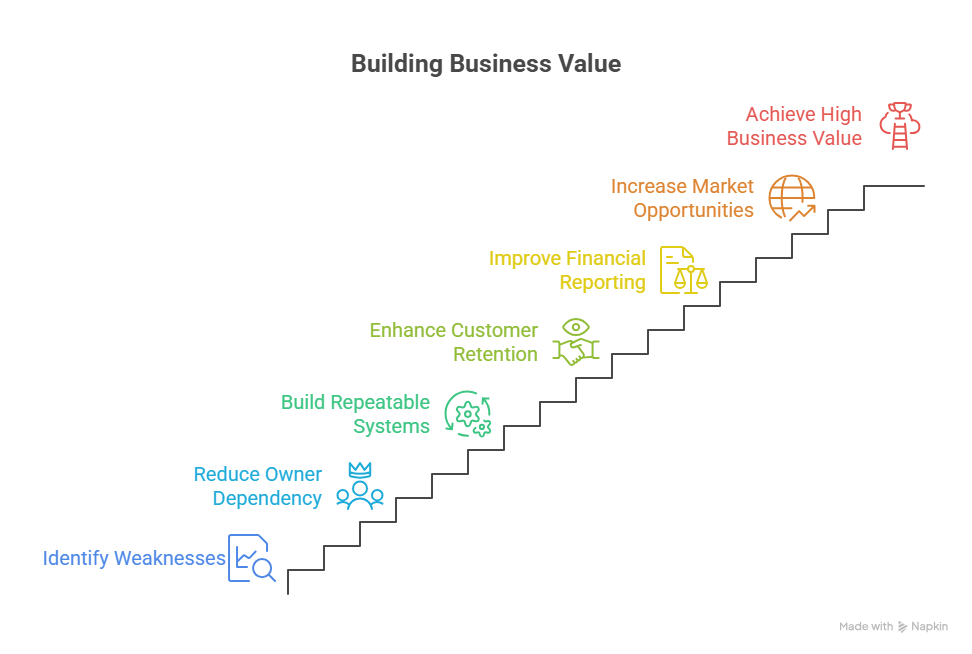
Building Business Value
Revenue Is Only Part of the Story
Roy and Brad open with a stark reality. Two businesses can produce identical revenue and still have dramatically different values. A buyer does not just look at the top line. A buyer looks at cash flow, financial reporting, recurring revenue, customer retention, management, technology, operating systems, contracts, market opportunities, and how dependent the company is on its current owner.
This is the gap most owners do not see. They equate revenue with value. But value is determined by much more than revenue. A million-dollar business with strong systems, multiple managers, recurring contracts, and low owner dependency is worth far more than a million-dollar business that falls apart if the owner takes a week off.
That is why Roy recommends getting a business valuation before you are ready to sell. A valuation can help identify weaknesses while you still have time to improve them. Do not wait until you need the money to discover that your business is not worth what you thought.
The Owner Dependency Trap
Roy shares his own experience. Early in his business, he realized that his company had become too dependent on him. Every important decision revolved around him. Every major customer relationship was with him. Every key process required his involvement. If he disappeared, the business would struggle.
This dependency destroyed value. A buyer looks at that and sees risk. If the business cannot produce results without the owner, then buying it is like hiring an employee who might or might not show up after the purchase is complete.
Brad emphasizes that this is one of the most common value killers. A business becomes more transferable when customers, employees, and operations do not depend entirely on the owner. The solution is systematic.
Build Repeatable Systems — The Foundation of Value
The way to reduce owner dependency is to build repeatable systems. This means documented procedures. This means training. This means technology that replaces manual work. This means clearly defined responsibilities so people know what they are supposed to do without asking the owner.
When Roy built systems into his business, something changed. The company could produce results even when he was not there. Decisions could be made without him. Customer relationships had depth beyond the owner. The business became valuable because it could function without him.
This does not mean the owner steps away entirely. It means the business can continue at a certain level of effectiveness without the owner being the linchpin. That is what a buyer looks for. That is what creates value.
Get the Financials Right — Show What You Have
Roy and Brad stress the importance of reliable financial reporting. A buyer wants to see clean books. They want to understand the true cash flow. They want to see trends. They want to see what is sustainable and what is dependent on one-time sales or circumstances.
Many business owners have never shown their financials to an outside professional. They do not know if their books are reliable. A buyer will definitely check. And if the financials are a mess, it signals risk. Even if the business is actually performing well, poor financial reporting will hurt the valuation.
Get your books in order. Hire a good accountant. Make sure your financial statements are clear, accurate, and auditable. This is not just about taxes. This is about demonstrating that your business is worth what you think it is.
Recurring Revenue — The Holy Grail
Brad emphasizes that recurring revenue is one of the most valuable business characteristics. A business with customers who pay every month is worth more than a business that depends on winning new customers every month to stay alive.
Think about it from a buyer’s perspective. If you buy a business with recurring revenue, you can predict cash flow. You can plan for growth. You have stability. If you buy a business where every sale is a new battle, there is uncertainty.
If your business is transaction-based, look for ways to create recurring revenue. Subscriptions. Retainers. Memberships. Packages. Anything that gets customers to commit to multiple payments over time.
Succession Planning — Prepare for What You Cannot Control
Roy and Brad discuss succession planning. Most owners think of succession planning as retirement. But succession planning is also about what happens if you die. If you become disabled. If you get divorced. If you face unexpected circumstances that force a transition.
These are not pleasant topics to think about. But they are critical. If something unexpected happens and you have no plan in place, your family could face financial devastation. Your business could be forced into a hasty sale at a fraction of its value. Customers could leave. Employees could scatter.
Succession planning now protects you and your business later. It also signals to a potential buyer that you have thought things through. That you have planned for continuity. That the business does not just depend on you surviving.
Buy-Sell Agreements — Protect Ownership
Brad discusses buy-sell agreements. If you have business partners, a buy-sell agreement determines what happens to ownership when a partner dies or another triggering event occurs. Without one, you could end up in a messy situation where the partner’s family now owns a piece of your business.
A buy-sell agreement can specify that if a partner dies, the remaining partners have the right to buy that partner’s share at a predetermined price. It can be funded by life insurance so the money is available when needed. It keeps the business in the right hands and protects all parties.
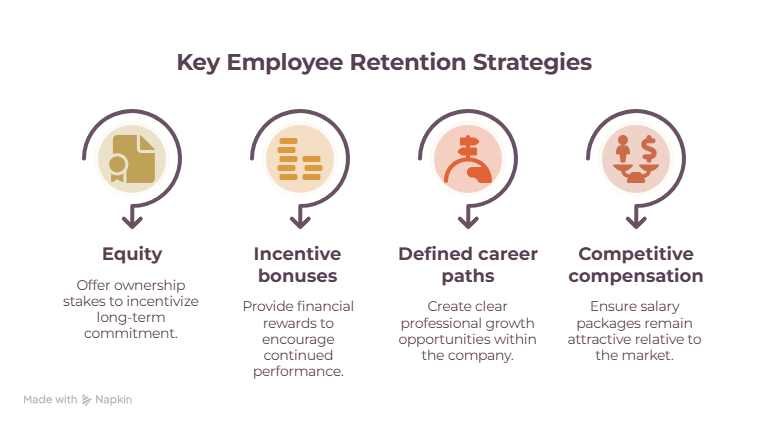
Key Employee Retention Strategies
Key Employee Retention — Identify the People Who Matter
Roy and Brad emphasize the importance of identifying key employees. Not all employees are created equal. Some have specialized knowledge. Some have deep customer relationships. Some drive a disproportionate amount of revenue. Their departure could significantly affect the business value.
Once you identify these people, put a plan in place to retain them. It might be equity. It might be incentive bonuses. It might be defined career paths. It might be competitive compensation. Whatever it is, do not let your most valuable people walk out the door because you took them for granted.
From a buyer’s perspective, knowing that key employees are committed to staying is huge. It de-risks the acquisition. It means the knowledge, relationships, and capability stay with the business.
Is It a Business or a Job?
Roy asks the defining question: is it a business, or is it a job that you have no boss?
A business is something that produces value independent of your personal involvement. A job without a boss is what most solo entrepreneurs have. They are trading their time for money. There is no business value because there is no business — just an owner who happens to be good at what they do.
The path from job to business requires building systems, hiring people, creating processes, and reducing owner dependency. It is not quick. It is not easy. But it is the only path to building something that is actually worth money.
Prepare Before You Need to Exit
Roy and Brad’s final message is clear. The best time to make your business more valuable is long before you need or want to sell it. Not when you are ready to retire. Not when an unexpected event forces your hand. Now.
Start building systems today. Get your financials right today. Identify and retain key employees today. Put succession planning in place today. Build a business that can operate without you today.
Then, whether you sell in five years or thirty years, you will have options. You will have value. You will have built something that actually is a business.
Ready to Evaluate Your Business Value?
If you are a business owner and you have never had a formal business valuation, now is the time. Understanding where your business stands today can help you identify opportunities to strengthen operations, protect what you have built, and prepare for whatever comes next.
Visit roymatlockjr.com/business-valuation or call 615-843-2999 to explore a business valuation. Roy and his team work specifically with business owners to understand business value, succession planning, and strategic transitions.
Explore more business services at roymatlockjr.com/business-services.
Listen to the Full Podcast
This episode features Brad O’Bryan and Roy Matlock Jr. discussing business valuation, systems, succession planning, and what actually makes a business valuable. Listen to the full August 15, 2026 episode of The Roy Matlock Jr. Money and Business Hour here: PODCAST: August 15, 2026
Watch the full video on YouTube: What Is Your Business Really Worth?
Business Owners on the Air with Roy
Are you a successful small business owner, or maybe you know someone who is! Roy wants to interview business owners who have success stories for inspiration to our listening audience, to share their journey from starting out to success. Nominate someone you may know, or yourself, by clicking here.
