
Financial Independence Playbook: Complete Plan From Protection to Retirement

Building financial independence does not have to be complicated. The industry has made it seem difficult. The financial world is filled with terminology, competing products, conflicting advice, and endless noise. But at the core, the path to financial independence follows a simple pattern.
In this episode of The Roy Matlock Jr. Money and Business Hour, Roy walks through the financial planning process from beginning to end. From establishing a strong foundation and protecting your income to investing consistently, compounding wealth, and eventually creating reliable retirement income. It is a complete roadmap for financial success at every stage of life.
The Challenges Everyone Faces
Before diving into the solutions, Roy acknowledges the financial pressures people deal with every day.
Rising living costs are real. A coffee that cost $2.64 now costs $3.24. Gas prices, housing costs, everything is more expensive. It is not your imagination. It is happening.
Interest rates are higher than they have been in years. Home loans cost significantly more than they did a few years ago. Credit cards charge 18%, 21% interest. Student loans hang over millions of people. When you borrow money, you are paying a serious price for it.
Most people do not have enough emergency savings. An unexpected bill quickly becomes new debt. And that debt becomes what Roy calls bad debt. Bad debt is tied to things that go down in value or charge high interest rates.
Protection gaps exist everywhere. People buy insurance trying to get the cheapest price when the real goal is to never use it. But if something happens, they discover they are underinsured.
Many people delay investing. Time is being wasted. And the cost of that lost time is enormous.
There is too much financial noise. Every news story seems to demand an immediate decision. What about the market? What about interest rates? What about the economy? But noise is just noise. A plan is what matters.
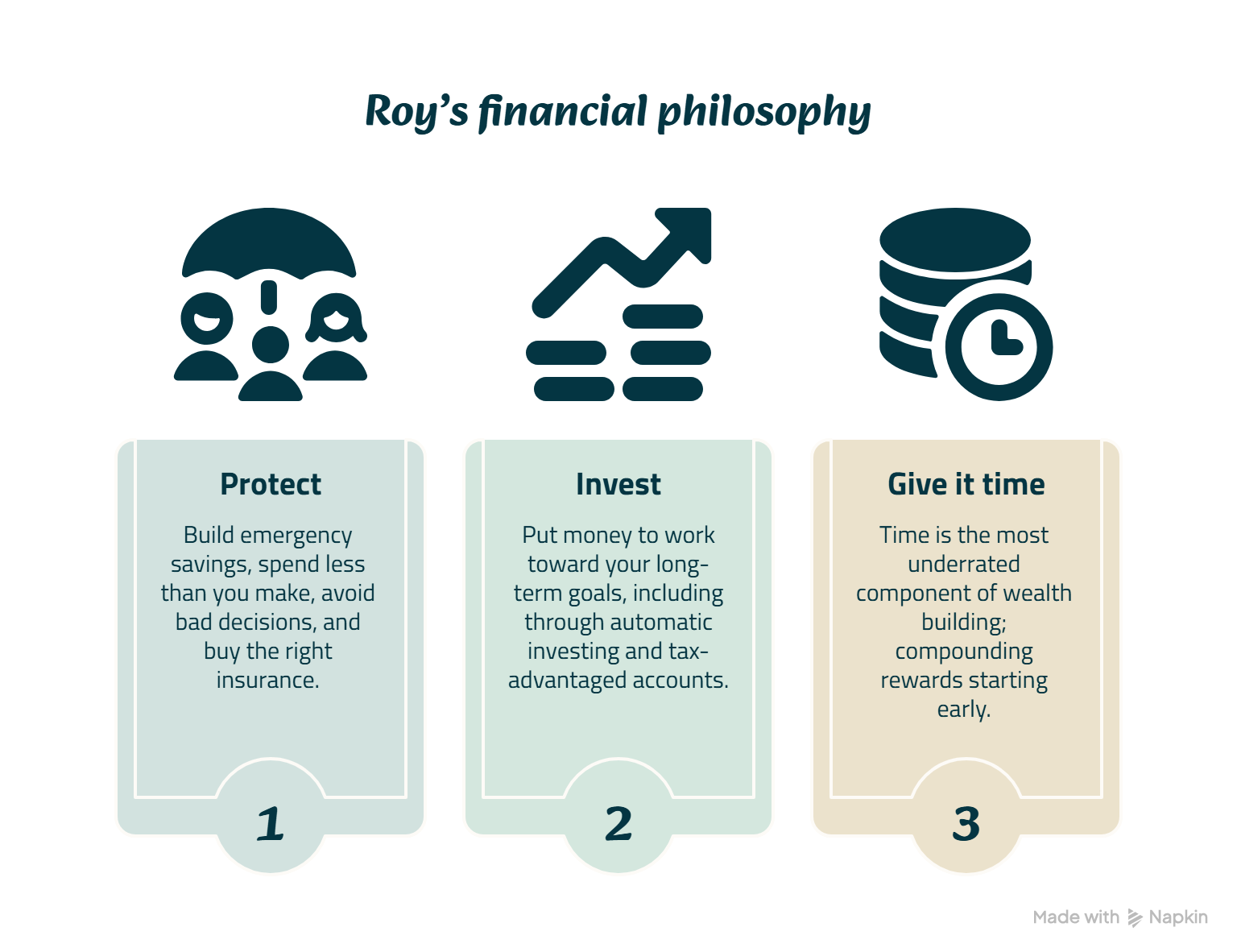
Roy’s financial philosophy
A Simple Framework That Works
Roy’s entire financial philosophy comes down to three things: protect, invest, and give it time.
That is it. Three simple concepts that apply to everyone, whether you are just starting out or preparing for retirement.
Step One: Protect
Protection means several things. It means building a foundation of emergency savings. It means spending less than you make. It means avoiding bad decisions that create unnecessary long-term stress.
It means buying the right insurance. If you have a family and you are still earning income, your income is one of your greatest financial assets. If something happens to you, your family loses that income. Term life insurance protects them. It is cheap. You can get millions of dollars of coverage for a small monthly premium.
Protection also means ensuring your home, car, and liability are covered. You want to transfer the risks you cannot afford to absorb to an insurance company. A lawsuit can destroy your finances. An umbrella policy costs very little and protects you against that risk.
One of the mistakes Roy sees constantly is people buying insurance based on price instead of protection. When you are never going to use it, why would the cheapest option be the best option? The goal is to have enough coverage so that if something happens, you are protected.
Protecting Your Income
Roy emphasizes that your ability to earn income is fundamental. An advisor’s job is to help you protect that income and the assets you build with it.
In the early stages of your career, your income is your greatest asset. You may not have accumulated much yet, but you have decades of earning potential ahead of you. Protecting that income—and the people who depend on it—is critical.
As you age and accumulate assets, the focus shifts slightly. You are protecting both your ability to earn and the wealth you have already built. Eventually, in retirement, the focus becomes making sure that wealth can support you for life.
Step Two: Invest
Once you have a foundation in place and you are protecting yourself, the next step is putting money to work toward your long-term goals.
One of the simplest ways to build wealth is to make investing automatic. Set up a monthly transfer from your checking account to an investment account. Roy calls it paying yourself first. You commit to investing a specific amount before you pay any other bills.
The magic thing about this approach? People almost never cancel it. It becomes as automatic as any other bill. You do it every month. It becomes a habit. And over decades, that habit compounds into serious wealth.
Using Tax-Advantaged Accounts
The government gives you reasons to save and invest. These come in the form of tax advantages.
If your employer offers a 401(k) match, that is free money. You contribute $3 and the company adds $3. That $6 then grows and compounds for decades. How could you not do that?
If you are self-employed, you have SEP IRAs, Solo 401(k)s, and other options.
Roth IRAs allow your money to grow tax-free. Health Savings Accounts let you save for medical expenses with a tax deduction. Inheritance accounts can let your money pass to your heirs without them paying taxes on the growth.
The government is essentially offering to help you build wealth if you put your money in the right places. It makes no sense to ignore that offer.
Professional Money Management
Roy believes that the average person will never be able to outperform professional money managers. They have teams of analysts studying companies, attending industry conferences, analyzing research and development pipelines, and staying on top of market trends. You cannot do that while working your regular job.
This does not mean you cannot pick individual stocks if you want to. It simply means that your core long-term wealth building should be done through diversified, professionally managed funds.
Mutual funds allow you to pool your money with thousands of other investors. The professional manager selects stocks, bonds, or other assets based on a stated investment objective. You choose the objective that matches your goals. The manager does the detailed work.
You start with $50 a month. You set it and forget it. The manager watches it constantly while you are sleeping. Over a long period of time, you see your money grow.
Understanding Asset Allocation and Diversification
Roy mentions that there are roughly 9,000 mutual funds available. The goal is to select a mix that matches your goals and time horizon. You might choose some growth funds, diversified portfolios, and bonds depending on when you will need the money.
As you get closer to retirement, you might shift toward more conservative allocations. If you are young and will not touch the money for 30 years, you can accept more volatility in exchange for higher long-term growth potential.
The key is that your allocation should match your time horizon, not the latest news story.
Step Three: Give It Time
Time is the most underrated component of wealth building.
Roy demonstrates the power of time with the Rule of 72. Take your rate of return and divide 72 by that number. The result tells you how many years it takes your money to double.
At 1% return, your money doubles in 72 years. At 6%, it doubles in 12 years. At 10%, it doubles in 7 years. At 12%, it doubles in 6 years.
The difference between 1% and 10% over decades is not just a few extra thousand dollars. It is millions of dollars.
When money doubles every 7 years instead of every 36 years, you get a very different outcome.
The Cost of Procrastination
Roy returns repeatedly to procrastination as the biggest mistake people make. It is easy to understand why. The numbers are stark.
If you start investing $500 per month at age 25 and earn 10% annually, you will have roughly $3 million by age 65. If you wait 10 years and start at 35, you will have about $1 million. If you wait until age 45, you will have roughly $380,000. If you wait until 55, you will have less than $100,000.
The difference is not just the contribution you missed. It is all the compounding that happened on those earlier deposits.
Another way to look at it: to accumulate $1 million by age 65, you need to save $158 per month starting at age 25. If you wait until age 35, you need to save $442 per month. If you wait until age 45, you need to save $1,375 per month. If you wait until age 55, you need to save $4,800 per month.
Procrastination does not just cost you time. It costs you money. It costs you options. It costs you peace of mind.
An Example of Rate of Return Impact
Roy gives another concrete example. You invest $10,000 for 40 years.
At 4% return, you end up with $48,000. At 8%, you end up with $217,000. At 10%, you end up with $453,000. At 12%, you end up with $931,000.
Same initial investment. Same time period. Same effort. But dramatically different outcomes because of the rate of return.
This is why professional money management and consistent, automated investing matter. They get your money working for you. They help you earn a reasonable return on your capital rather than letting your money sit earning 1% in a savings account.
A Financial Plan for Every Stage of Life
Roy emphasizes that your financial priorities change as you age.
Early in your career, the focus is on protecting your income. You have decades of earning potential. If something happens to you, your family needs to be protected. You need robust life insurance, disability insurance, and emergency savings.
In the middle stages, you are accumulating wealth. You are raising children. You are building retirement accounts. You are investing regularly. The focus is growth.
As you approach retirement, the focus begins to shift. You are still investing, but you are also thinking about how to transition from accumulation to withdrawing. You need to make sure your retirement income will last. You may need to guarantee certain income streams. You start thinking about your legacy.
In retirement, your primary goal is generating enough income to live on without running out of money. You want reliable, lifetime income from your social security, your pension (if you have one), and your investments.
Why Simplicity Matters
Roy returns to a key theme throughout the episode: the financial industry has made financial planning more complicated than it needs to be. Some companies benefit from your confusion. When you do not understand something, you feel like you need them.
Roy’s approach is the opposite. He educates his clients extensively. He wants them to understand the concepts. When they understand why he recommends what he recommends, they are much more likely to stay the course. And staying the course is what leads to success.
The message is simple. Protect what you have. Invest in your future. Give your money time to work. That is the entire playbook.
You Can Start Today
Roy works with people at every stage. Some are just beginning. Some have substantial assets. Some are retiring. The age does not matter as much as getting started.
If you are just starting, starting early gives you the greatest advantage. You have decades of compounding ahead of you.
If you are in the middle, starting now gives you years to build toward your goals. Every month you delay costs you future compound growth.
If you are close to retirement, it is time to make sure your income plan is solid. It is time to review your insurance and asset protection. It is time to lock in your vision for retirement.
No matter where you are, the most important step is having a plan and putting it into action.
Listen to the Full Podcast
This episode walks through the complete financial planning framework from protecting what you have to investing for the future to creating retirement income. Listen to the full September 26, 2026 episode of The Roy Matlock Jr. Money and Business Hour here: PODCAST: September 26, 2026
Watch the full video on YouTube: The Financial Independence Playbook: Protect, Invest & Give It Time
Business Owners on the Air with Roy
Are you a successful small business owner, or maybe you know someone who is! Roy wants to interview business owners who have success stories for inspiration to our listening audience, to share their journey from starting out to success. Nominate someone you may know, or yourself, by clicking here.
