

podcast
The Blueprint for Financial Freedom: Quick Tips to Fix Your Finances


After nearly 40 years of helping people take control of their money, I’ve learned that financial success isn’t complicated—it just requires following a proven system. Today, I’m sharing the complete blueprint that has helped thousands of families eliminate money stress and build lasting wealth.
The Six-Step Framework for Financial Success
Every client who works with me goes through the same proven process:
- Education and Advice – Understanding money fundamentals
- Initial Review – Assessing where you are today
- Defense – Protecting income and assets
- Offense – Growing wealth for financial independence
- Product Marketplace – Matching the right tools to your situation
- Updates – Adjusting as life changes
This framework eliminates the guesswork and creates an automated path to financial freedom. Let me break down each component so you can start implementing it today.
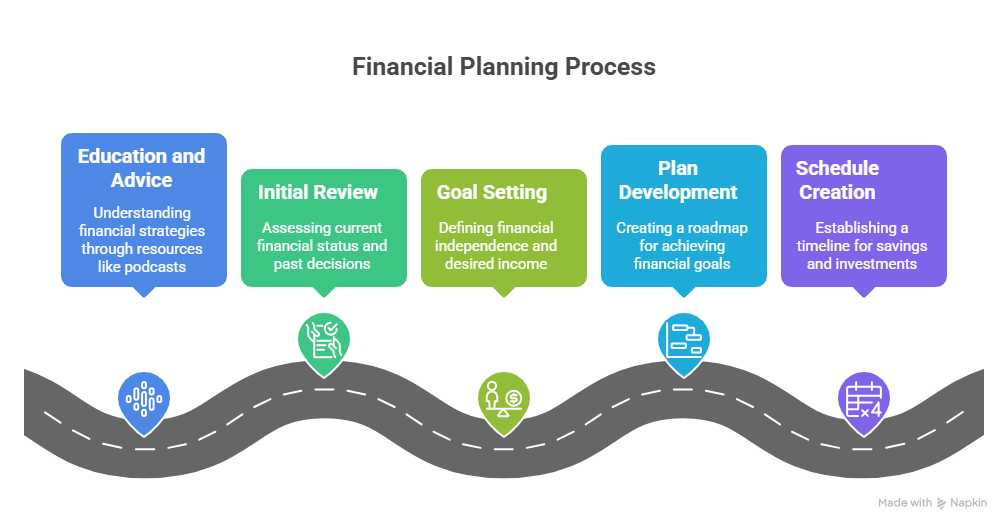
Financial Planning Process
Step 1: Education and Advice
The first step to fixing your finances is understanding what you’re doing well enough to explain it to a friend. If you can’t clearly articulate your financial strategy, you don’t have one.
That’s why I’ve created The Roy Matlock Junior Money and Business Hour podcast—with over 65,000 listens, it’s helping people across the country master money management. Education isn’t optional; it’s the foundation everything else is built on.
Step 2: Initial Review – Where Are You Today?
Before you can plan where you’re going, you need to understand where you are. Take an honest inventory:
- What have you done right with your money?
- What mistakes have you made?
- What’s your current income?
- What are your expenses?
- What assets do you have?
- What debts are you carrying?
I had a friend who started funding Roth IRAs for his daughters when they were little, having them do small tasks for his business. Fifteen years later, those girls are in their early twenties with substantial tax-free investment accounts. That’s the power of starting with a clear plan and executing it consistently.
Step 3: Your GPS – Goal, Plan, Schedule
Think of your financial future like a road trip. You need three things:
Goal: Where Are You Going?
Financial independence means having enough investment income that you never have to depend on working again. The rule of thumb: 20 times your desired annual income equals financial freedom.
Need $100,000 per year to live comfortably? You need $2 million invested. At 5% return, that $2 million generates $100,000 annually without touching the principal.
Plan: How Will You Get There?
Determine how much you need to save monthly based on:
- Your current age
- Your target retirement age
- Expected investment returns
- Current savings
Schedule: When Do You Want to Arrive?
If you’re 25 and want to be financially independent by 45, you have 20 years. Factor in inflation (money doubles every 20 years), so that $100,000 in today’s dollars needs to be $200,000 in 20 years. That means you actually need $4 million.
With this information, you can calculate exactly what you need to save monthly at a given interest rate to hit your target. The Rule of 72 helps here: divide 72 by your interest rate to see how many years it takes your money to double.
The Defense: Protecting What You Build
A typical financial mistake costs between $50,000 and $500,000 over your lifetime. Your defense prevents these costly errors.
The Budget: Fire Your Expenses
Here’s my radical budgeting approach: Fire all your expenses.
Seriously. Pretend you have zero expenses and ask yourself: “Which expenses would I rehire?” This forces you to examine every line item critically.
I learned this lesson the hard way in 1986. At 25, newly married, I bought a house and two brand new cars with payments totaling about $500 a month. When my income didn’t cooperate, I realized how stupid that was. So I got radical:
- Sold both new cars (at a loss)
- Bought two used diesel VW Rabbits that got 50 miles per gallon
- Eliminated both car payments within a year
- Moved to a more affordable house
Was it glamorous? No. Those VWs went from zero to 80 mph like you were riding behind an 18-wheeler. But within five years, I was living comfortably on 50% of a much higher income and saving consistently.
The lesson: Sometimes you have to get uncomfortable to get ahead. Fire the expenses that are holding you back.
The 50-25-25 Rule
Target this breakdown:
- 50% – Living expenses
- 25% – Savings and investments
- 25% – Taxes
Can’t do it with your current income? Then your number one priority is raising your income by becoming more valuable in the workplace, starting a business, or outworking your competition.
The Two-Account Budget System
Stop trying to track every penny. Here’s the simple system I use and teach:
Account 1: The Draft Account
- All income flows in
- All automated expenses flow out (mortgage, utilities, insurance, savings)
- Everything is on autopilot
Account 2: Weekly Spending Account
- Transfer your weekly allowance every Sunday
- Use a debit card for discretionary spending
- Get daily balance alerts via email or text
- When it’s gone, it’s gone until next Sunday
If you’re married, each spouse gets their own weekly account with a debit card. No arguments, no tracking—just simple, automated control.
A budget isn’t an accounting system (looking backward at what you spent). A budget is a decision-making tool (planning forward how you’ll spend).
Emergency Fund: Your Financial Shock Absorber
Build 3-6 months of expenses in liquid cash:
- Dual income household: 3 months
- Single earner: 6 months
Why is this critical? The return on your emergency fund isn’t the 3% interest—it’s everything you avoid:
- Raised deductibles on insurance (saving hundreds annually)
- No early withdrawal penalties from retirement accounts
- No borrowing at 18% on credit cards
- No losing your car to repossession
- No selling investments when markets are down
An emergency fund isn’t just money sitting there—it’s insurance against making desperate financial decisions.
Getting Out of Bad Debt
Let’s define debt properly:
Bad Debt
- You can’t comfortably afford the payment
- It’s tied to something that depreciates (cars, credit cards, consumer goods)
Good Debt
- You can easily afford the payment
- It’s tied to appreciating assets (home, rental property, business equipment)
If you’re in bad debt, here are your options:
Strategy 1: Levelize Your Payments
Credit card companies love minimum payments because they keep you in debt for 10-30 years. As you pay down the balance, your minimum payment decreases, extending the payoff period.
Simple fix: Lock in this month’s payment as your permanent payment. If you’re paying $100 this month, set up an automatic $100 payment every month. This drops your payoff timeline from 30 years to about 3 years. It’s crazy effective.
Strategy 2: Debt Snowball
Pay minimum payments on everything except your smallest debt. Attack that one with everything extra you have. When it’s paid off, take that entire payment and add it to the next smallest debt. The momentum builds as you knock them out one by one.
Strategy 3: Consolidation
Use a home equity line of credit to consolidate high-interest debt into one lower-interest payment. Critical warning: This only works if you’ve already changed your spending habits with a budget. Otherwise, you’ll end up with a consolidation payment PLUS new credit card debt.
The Money Game Car Story
When I co-hosted with Dave Ramsey, we did a remote broadcast at a used car dealership in Rivergate that sold cheap cars—$750 to $1,500 vehicles. We made bumper stickers that said: “Don’t laugh. It’s a Money Game car” (meaning it was paid for).
One of our advisors bought a $750 car to eliminate two car payments. He parked it at Hickory Hollow Mall, and someone backed into it. The insurance estimate? $1,250 for damage on a $750 car!
Less than three years later, by driving that cheap car, cutting expenses, and saving aggressively, this same advisor had saved over $100,000. That’s the power of getting radical with debt elimination.
The Insurance Defense
Insurance accomplishes two things: protect income and protect assets.
Life Insurance: Two Types
Term Life Insurance (Income Protection)
- Pure death benefit, no cash value
- Cheapest coverage available
- Rule of thumb: 10x your annual income
- Length: Until you’d normally retire (15-35 year terms)
Example: Make $100,000? Buy $1 million in coverage.
Pro tip: Get policies with living benefits riders. These allow you to access up to 90% of your death benefit if you develop a critical illness, chronic illness, or terminal diagnosis (12-24 months to live). This provides money for care while you’re still living.
Permanent Life Insurance (Estate Planning)
- Kept until death
- Builds cash value
- Pays for final expenses
- Replaces lost Social Security income for surviving spouse
- Can pay estate taxes
- Changes your family tree by leaving a legacy
If you hold permanent life insurance to death, it turns out to be an excellent investment and ensures you leave something substantial for your beneficiaries.
Disability Insurance: The Forgotten Protection
I believe becoming disabled is worse than dying. If you die, your family gets life insurance. If you’re disabled without coverage, you can’t work, can’t earn, and can’t fix the situation.
Disability insurance typically replaces 60-70% of your income. The cost depends on:
- Waiting period (90 days vs immediate coverage)
- Amount of coverage
With a solid emergency fund, choose a 90-day waiting period to reduce premiums.
Health Insurance: Asset Protection
Health insurance prevents medical bills from destroying everything you’ve built. Options include:
- Employer coverage
- High-deductible plans
- Health share plans (which I’ve used for years)
Money-saving tip: Negotiate medical costs in advance. Thirty-three years ago, I negotiated the labor and delivery costs for my first child by paying cash upfront. You can typically get 50% or more off any healthcare procedure by paying in advance.
Property & Casualty Insurance
Home and Auto:
- Adequate liability coverage (protect against lawsuits)
- Umbrella policy of $1-2 million (your “cheap lawyer”)
- Higher deductibles as your emergency fund grows ($1,500-$2,500)
Renter’s Insurance:
- Covers liability (dog bite, visitor injury)
- Covers contents
Pro tip: Work with an independent agent who represents multiple carriers. Different companies prefer different risk profiles, so shopping around can save you hundreds.
The Secret Emergency Fund: Home Equity Line of Credit
Here’s something most people don’t think about: Get a home equity line of credit WHILE YOU’RE WORKING, even if you don’t need it.
Why? Bankers love lending to people who don’t need money and can easily repay it. They hate lending to people who desperately need money and might not be able to pay it back.
Get that equity line established when your credit is good and you’re employed. Then it sits there as a massive emergency fund if you ever need it. Buy the umbrella before it rains.
Estate Planning: The Living Part
Over 60% of Americans don’t have basic estate planning in place. At minimum, you need:
- Health Care Power of Attorney: Someone who can make medical decisions if you can’t
- Financial Power of Attorney: Someone who can pay your bills and manage finances if you’re incapacitated
- Will or Living Trust: Directs where your assets go
- Beneficiary Designations: On all accounts
This isn’t just for when you die—it’s for when you’re alive but unable to function normally.
Taking Action Today
Here’s what to do right now:
- Download resources from roymatlockjr.com (budget worksheet, retirement calculator, financial needs analysis)
- Fire your expenses and create your two-account budget system
- Build your 3-6 month emergency fund
- Get proper insurance (term life, disability, health, liability)
- Eliminate bad debt using leveling or snowball method
- Set up your GPS (Goal, Plan, Schedule)
Remember: I’m an implementer of automations. My job is to help you set up systems that work automatically so you don’t have to think about money every day. You automate the right behaviors, and one day you wake up financially free.
You’ve got enough worries in life. Let’s take money stress off the table.
Listen to the Full Podcast
Ready to dive deeper into each of these strategies? Listen to the complete episode where I walk through the entire blueprint step by step, answer common questions, and share more real-world examples of how these principles have transformed people’s financial lives.
Listen to the full podcast episode: “The Blueprint for Financial Freedom”
In this episode, I share additional stories from my 40 years in the financial industry, including the complete breakdown of defensive strategies, the exact insurance products I recommend, and how to work with a fiduciary advisor who puts your interests first. Don’t miss this comprehensive guide to eliminating money stress forever.
Business Owners on the Air with Roy
Are you a successful small business owner, or maybe you know someone who is! Roy wants to interview business owners who have success stories for inspiration to our listening audience, to share their journey from starting out to success. Nominate someone you may know, or yourself, by clicking here.
