
Turning Decades of Savings Into Reliable Income

You have spent 30, 40, or 50 years accumulating wealth. You automated your savings. You let compound interest work. You reached your financial independence number. Now what? This is the retirement red zone. This is the critical period roughly 10 years before retirement through the early years of retirement. And it is completely different from accumulation.
In this episode of The Roy Matlock Jr. Money and Business Hour, Roy shifts the conversation from how to build wealth to how to turn that wealth into income. This is the withdrawal stage. This is where your plan changes. Your allocation changes. Your tax strategy changes. Everything changes. Roy walks through the exact system he uses to help thousands of families transition from earning and saving to living on their investments.
The retirement red zone is not a guessing game. With the right plan, retirees can create regular income, reduce anxiety, protect against major risks, and make sure their family is not left with unnecessary financial complications.
The Three Stages of Financial Life — Accumulation, Withdrawal, Transfer
Roy has helped over $1 billion flow through his firm. And he has learned that financial life has three distinct stages.
**Stage One: Accumulation.** This is the stage where people save, invest, protect their income, and allow compounding to work over time. This is where you set up your budget, build your emergency fund, buy insurance protection, and automate your investments. This is where the $500 per month becomes $1 million. This stage can last 30, 40, or 50 years.
**Stage Two: Withdrawal.** This is the stage when your savings must now produce income. You are no longer putting money in. You are taking money out. Your paycheck is no longer coming from your employer. Your paycheck is coming from your investments. This stage lasts from retirement through the rest of your life — possibly 30 or 40 years.
**Stage Three: Transfer.** This is the stage where you make sure your assets pass smoothly to the next generation. You want your family to inherit your wealth, not your complications. That means updated beneficiaries, powers of attorney, healthcare directives, wills, trusts, and planning for blended families or business ownership issues.
Most people spend their entire career focused on stage one. Then they retire and realize they have no plan for stage two. That is a mistake.
Are You Ready to Retire? The Retirement Readiness Checklist
Before you can build your withdrawal plan, you need to answer some critical questions. Roy reviews these with every client approaching retirement.
First, what do you own? Do you own your home? What is it worth? Do you have a mortgage? What is the rate? Do you have bank cash or CDs? Do you have retirement plans set up? Do you have rental properties? Do you have any other assets?
Second, what do you owe? Do you have a mortgage payment? Car payments? Credit card debt? Business debt? Student loans? Any other liabilities?
Third, how much income do you need? What does your lifestyle cost? What will retirement cost? Be honest. If you are spending $8,000 per month now, you will probably spend $8,000 per month in retirement. Maybe less if you pay off the house or do not commute. Maybe more if you travel or have health expenses.
Fourth, what income sources do you have? What will you get from Social Security? Do you have a pension? What income will your investments generate?
Fifth, where is the gap? If your expenses are $8,000 per month and Social Security plus pensions give you $4,000 per month, you have a $4,000 gap. Your investments need to generate that $4,000 every month. That means you need roughly $1.2 million invested at a 4% withdrawal rate.
Sixth, what is your plan? How will your portfolio be allocated? What is your withdrawal strategy? What is your tax strategy? What about long-term care? What about leaving an inheritance?
Not every retiree is in the same position. Some are behind and may need to maximize income with little concern for inheritance. Others are on track and want both income and legacy planning. Those who are well ahead may need more advanced tax, estate, and wealth transfer strategies. The key is knowing where you stand.
Sequence of Return Risk — The Biggest Threat to Retirement
Roy wants everyone to understand one critical concept: sequence of return risk. This is the biggest threat to your retirement, and most people have never heard of it.
Here is what it means. Imagine you retire with $1 million. Your plan is to withdraw 4% per year, or $40,000. In a normal year, if the market goes up 10%, your account grows to $1.1 million. You withdraw $40,000, and you still have $1.06 million. You are fine.
But what if the market crashes 20% the year you retire? Your $1 million becomes $800,000. You still withdraw $40,000. Now you have $760,000. Then the market is flat. You withdraw $40,000. Now you have $720,000. By the time the market recovers, you have already done damage.
This is sequence of return risk. If you get big market declines early in retirement, it can devastate your plan. You are withdrawing when prices are down, locking in losses. This is different from accumulation, where you buy more shares at lower prices. In retirement, you are selling to pay bills.
To manage this risk, Roy uses several strategies. Balanced portfolios with stocks and bonds smooth returns. Income buckets keep some money in safe places. Annuities provide guaranteed income so you do not have to withdraw during market downturns. Cash reserves keep you from selling at the wrong time.
Building Your Retirement Income — Four Main Buckets
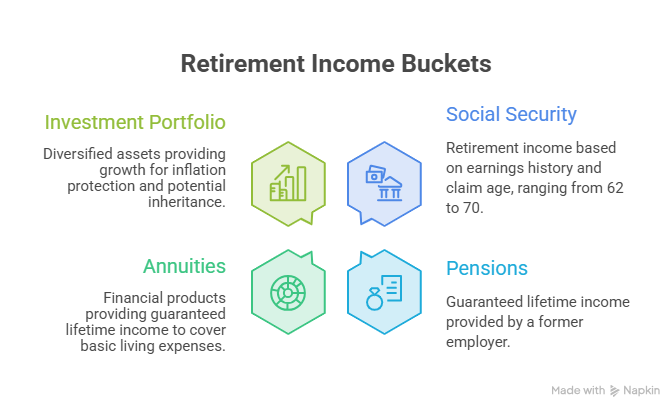
Roy builds retirement income plans using four main buckets.
**Bucket One: Social Security.** Most retirees qualify for Social Security. The amount depends on your earnings history and when you claim. Claiming at 62 gives you less. Claiming at 70 gives you more. Roy helps clients optimize this decision based on their life expectancy, spouse situation, and overall plan.
**Bucket Two: Pensions.** If you have a pension from a former employer, that is guaranteed lifetime income. Roy integrates this into your overall plan.
**Bucket Three: Annuities.** An annuity can provide pension-like lifetime income. Roy gives an example: a couple age 65 or 68 might be able to buy an annuity that pays 7% for the rest of their lives. If they invested $300,000, that is $21,000 per year — or $1,750 per month — guaranteed for life. This is useful for creating a floor of guaranteed income so basic living expenses are covered no matter what the market does.
**Bucket Four: Investment Portfolio.** The remaining assets stay invested in a diversified portfolio. This provides growth for inflation protection and leaves an inheritance. In retirement, this might be more conservative — perhaps 40% stocks and 60% bonds — compared to the 80/20 or 90/10 during accumulation.
The key is that these four buckets work together. Guaranteed income covers basics. The portfolio provides flexibility and growth. You are not solely dependent on any one source.
Tax Planning in Retirement — Different Than Accumulation
Taxes do not stop when you retire. In fact, tax planning becomes even more critical because you have more control over when and how much you withdraw.
Roy helps retirees think strategically about which accounts to withdraw from in what order. Should you take money from taxable accounts first or tax-deferred accounts? Should you take charitable contributions directly from your IRA to avoid taxes? Should you do a Roth conversion to manage your tax bracket? Should you coordinate your withdrawals with your spouse’s withdrawals?
There are all these different strategies. The key is having a plan before you retire so you can minimize taxes throughout retirement.
Long-Term Care Planning — Protect Against the Nursing Home Risk
One of the biggest financial risks in retirement is long-term care. A nursing home can cost $8,000 to $15,000 per month. An assisted living facility can cost $5,000 to $10,000 per month. If you live to 95 or 100 like Roy’s mother did, you could spend hundreds of thousands of dollars on care.
Roy’s mother lived to 102 just passed away. Roy did not want her outliving her money and running out of retirement money at 85. So he helped her plan for long-term care.
There are several strategies. Some people self-insure — they have enough money that they can pay for care themselves. Some people buy long-term care insurance. Some people buy hybrid annuities that provide long-term care riders. Some people rely on family help or Medicaid.
The key is having a plan. Do not assume it will not happen. One health event can change everything.
Estate Planning — Making Sure Your Legacy Passes Smoothly
The final part of retirement planning is making sure your wealth transfers smoothly to the next generation. Poor estate planning can create family conflict, legal delays, probate issues, and unintended outcomes.
Roy recommends several documents. First, a will that outlines who gets what. Second, a living trust that avoids probate and provides privacy. Third, healthcare powers of attorney and healthcare directives so someone can make medical decisions if you cannot. Fourth, financial powers of attorney so someone can handle finances if you become incapacitated.
Beyond documents, Roy also helps with strategy. Should you title assets jointly? Should you gift money to kids before you die or leave it in the will? Should you set up trusts for grandchildren? Should you have buy-sell agreements for business ownership? Should you plan for blended family situations?
These are the kinds of things that separate a smooth transition from a messy one.
Practical Examples — Different Situations
Not every retiree looks the same. Roy works with different situations.
**The behind-schedule retiree.** This person needs to maximize income and may take a reverse mortgage on their home. They may work a few more years. They may optimize Social Security by claiming at 70. They may buy an annuity to create guaranteed income. The focus is on stretching money as far as possible.
**The on-track retiree.** This person has saved well and has both income and some legacy goals. They use a mix of guaranteed income and investments. They may not need an annuity, or they may use a smaller one. The focus is on balance.
**The well-ahead retiree.** This person has more than they need. They are focused on legacy planning, tax optimization, and charitable giving. They may use investment accounts, not annuities. They may be doing advanced tax planning with Roth conversions. The focus is on passing wealth efficiently to the next generation.
Each situation requires a different plan. The key is knowing which situation you are in and building accordingly.
The Importance of Planning — Retirement Is Not a Guessing Game
Roy’s central message is simple: retirement should not be a guessing game. You worked too hard to get here to wing it now.
Take the time to answer the retirement readiness questions. Understand your income needs. Know your gaps. Build a withdrawal strategy. Plan for taxes. Plan for long-term care. Plan for transfers to the next generation.
With the right plan, you can retire with confidence. You know your money will last. You know your family is taken care of. You can sleep well at night.
Ready to Enter the Red Zone?
If you are 10 years away from retirement or already retired, this is the time to get serious about your plan. Do not guess. Do not hope. Do not assume.
Visit roymatlockjr.com/retirement-planning or call 615-843-2999 for a retirement planning consultation. Roy and his team can help you transition from accumulation to withdrawal with confidence.
Listen to the Full Podcast
This episode covers the complete transition into retirement — from readiness assessment to income planning to estate transfer. Listen to the full June 20, 2026 episode of The Roy Matlock Jr. Money and Business Hour here: PODCAST: June 20, 2026
Watch the full video on YouTube: The Retirement Red Zone: Turning Savings Into Income
Business Owners on the Air with Roy
Are you a successful small business owner, or maybe you know someone who is! Roy wants to interview business owners who have success stories for inspiration to our listening audience, to share their journey from starting out to success. Nominate someone you may know, or yourself, by clicking here.
