
Financial Review Process: Questions, Gaps & Life Stage Planning


Money is one of the biggest sources of stress for most people. Because of that, many people avoid financial planning altogether. Sometimes they procrastinate. Sometimes they worry they will be sold something. Sometimes they think they do not have enough money to work with an advisor. But what they really need is not more financial products. They need more financial clarity.
In this episode of The Roy Matlock Jr. Money and Business Hour, Roy walks listeners behind the scenes of a real financial review. This is not a sales pitch. This is not about pushing products. This is about starting with questions, providing education, and creating clarity. Roy shows what a proper financial review looks like for young professionals, families in their 40s, those approaching retirement, and widows or widowers facing financial decisions alone.
If you have ever wondered what happens in a financial review, this episode answers that question.
A Financial Review Starts With Understanding Your Story
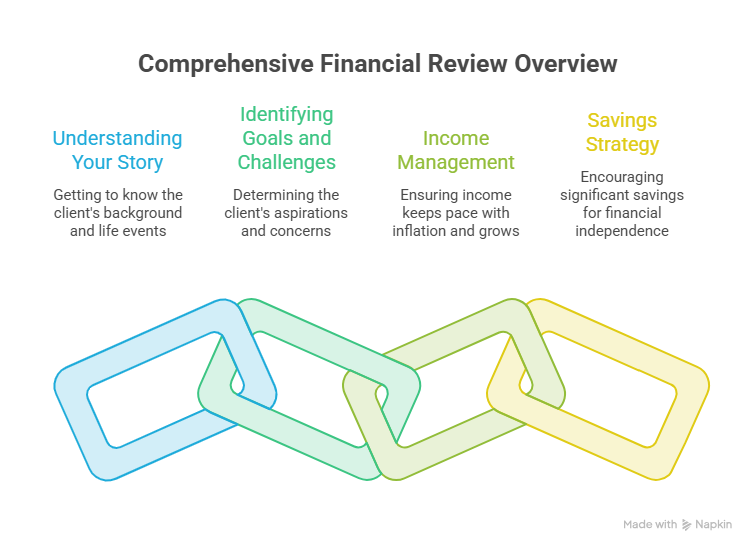
Roy begins every financial review the same way. He gets to know the person or family. He learns where they are from. What do they do for work? Do they have children? What major life events have recently happened? What is currently on their mind?
Roy has found that people often seek help after a life change. Marriage. Divorce. Having children. Changing jobs. Buying a house. Inheriting money. Dealing with unexpected taxes. Preparing for retirement. Facing rising expenses. These life events create urgency and clarity. They make people realize they need a plan.
The first part of a financial review is simply listening and understanding. Once Roy understands someone’s story, he can help.
Identifying Goals and Challenges — What Keeps You Up at Night?
The next step is identifying goals and challenges. Roy often asks two simple questions. “What do you want to accomplish?” and “What is keeping you up at night?”
These questions reveal whether the issue is credit card debt, retirement income, insurance concerns, old 401k accounts scattered from previous jobs, tax problems, business planning, or uncertainty about whether the current financial path is working.
Everyone has different concerns. A 26-year-old has different worries than a 55-year-old. A business owner has different concerns than an employee. A widow has different challenges than a couple. The key is identifying what matters most to that specific person or family.
Income — The Foundation of Everything
A major theme Roy emphasizes is the importance of income. Your income is the foundation. Without income, nothing else works.
Roy stresses that income must at least keep up with inflation, or you slowly fall behind even if you appear to be making more money than you did years ago. If you made $50,000 ten years ago and make $60,000 now, but inflation has been 3% per year, you are actually behind in real terms.
Roy encourages listeners to become more valuable in the workplace. Grow your earning potential. Invest in education and skills. Stay ahead of inflation. Then, once you have solid income, the next step is saving a meaningful percentage of it.
Roy mentions that saving 10% is a starting point, but saving closer to 25% can create real momentum toward financial independence.
Home Ownership and Home Equity
Roy walks through practical questions about home ownership. Do you own your home? What is it worth? What do you owe on it? What is your interest rate? Do you have access to a home equity line of credit?
Home equity can be useful. It is leverage. But Roy stresses that you need access to it before a crisis occurs. If your credit is damaged or your home value drops, suddenly you cannot get a line of credit. Set it up when times are good.
Roy also cautions that paying off a low-interest mortgage early may not be the best use of cash. If you have a mortgage at 3% and the stock market has historically averaged 10%, you may be giving up returns by paying off that mortgage. The math often favors investing instead.
It is not about being aggressive or conservative. It is about understanding the math and making informed decisions.
Debt — High-Interest vs Low-Interest
Roy discusses the critical difference between low-interest debt and high-interest debt, especially credit card debt.
He explains that if someone has cash sitting in the bank earning 1% interest while also carrying high-interest credit card balances at 18% or 20%, they are losing significant money in interest. In many cases, it makes more sense to keep a basic emergency fund and apply excess cash toward paying down high-interest debt.
Roy gives this example: if you have $10,000 in the bank earning 1% and $5,000 in credit card debt at 18%, you are losing about $900 per year in net interest. Pay off the credit card. Keep your emergency fund. Your money will work better for you.
Budgeting and Expense Control — The Expense Review
Roy encourages listeners to review each expense and ask a simple question: “If I did not have this bill right now, knowing what I know, would I have started it again?”
This question is powerful. Subscriptions you do not use. Memberships you never go to. Services you forgot you were paying for. Insurance you do not need. If the answer is no, cut it. Redirect that money toward savings, investing, or debt reduction.
Roy points to the budget form available at roymatlockjr.com as a resource. Download it. Fill it out. See where your money is actually going. Then make conscious choices about what to keep and what to cut.
Insurance and Protection — The Defensive Side
Roy describes insurance and protection planning as the defensive side of a financial plan. This is where you protect yourself and your family.
Roy discusses the importance of term life insurance for anyone with dependents, mortgage obligations, or family responsibilities. He also touches on disability income protection, health insurance, health savings accounts, home and auto insurance, umbrella liability coverage, and making sure deductibles and coverage levels are appropriate.
The key is having a plan. Most people have pieces of protection but not a coordinated strategy. A financial review identifies gaps in that protection.
Estate Planning — Protecting Your Family After You Are Gone
Estate planning is another important part of the review process. Roy talks about wills, trusts, financial powers of attorney, healthcare powers of attorney, living wills, and making sure beneficiaries are current and appropriate.
Roy emphasizes that not having documents in place can create unnecessary stress, confusion, and conflict during already difficult times. Blended families need special attention. Minor children need guardianship provisions. If you own a business, you need a succession plan.
The goal is to make sure that if something happens to you, your family is not left with unnecessary financial complications on top of their grief.
Real-Life Examples — Different Life Stages
Roy walks through several examples to show how financial reviews work for different people.
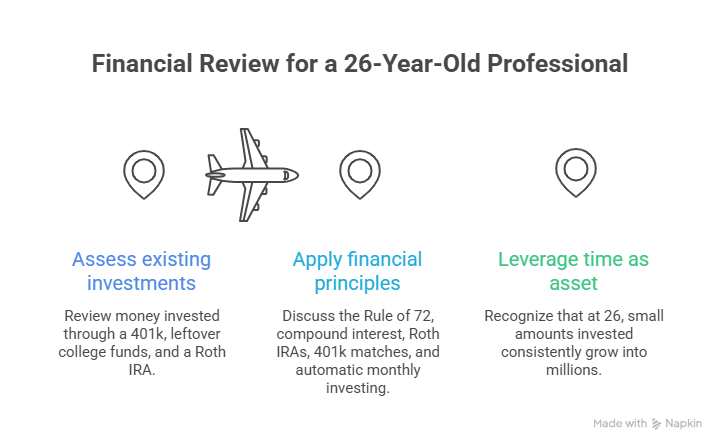
**A 26-year-old professional.** Roy gives an example of a 26-year-old who already had money invested through a 401k, leftover college funds, and a Roth IRA. Roy uses that story to show the power of early planning, family financial education, and automation. He discusses the Rule of 72, compound interest, Roth IRAs, 401k matches, and the value of setting up automatic monthly investing. At 26, time is your greatest asset. Small amounts invested consistently grow into millions.
**A family in their 40s.** Roy gives an example of someone with children, a mortgage, and a solid 401k balance. But when Roy digs deeper, he finds they are underinsured. They are missing estate planning documents. They lack proper liability protection with an umbrella policy. They are not maximizing retirement savings. Even people who appear to be doing well financially can still have major gaps in their plan.
**Those approaching retirement.** Roy discusses retirement income planning, sequence of return risk, asset allocation, Roth conversions, tax planning, and cash management. Someone with significant savings needs a different strategy than someone still in the early accumulation phase. Retirement is the time to shift from accumulation to income.
**Widows and widowers.** Roy speaks to people who have lost a spouse. He explains that losing someone is stressful enough without also being overwhelmed by scattered accounts, unclear documents, or a lack of trusted decision-makers. He encourages listeners to make sure accounts, beneficiaries, powers of attorney, and trusted contacts are organized now, before a crisis occurs.
What an Advisor Should Be — Coach, Guide, Specialist
Roy reinforces an important concept. A financial advisor should function more like a coach, guide, or specialist — someone who can ask the right questions, identify blind spots, educate the client, and recommend strategies based on actual needs.
The goal is not to sell products. The goal is to help people protect what they have, grow what they can, avoid costly mistakes, and create a clearer path toward financial independence.
If an advisor starts by showing you products, walk away. If an advisor starts by asking questions about your life, your goals, and your challenges, that is a good sign.
The Real Value of a Financial Review
Roy’s central message is that a financial review provides value at every life stage. It is not just for wealthy people. It is not just for people who think they need help. Everyone benefits from an outside perspective on their finances.
A review can identify gaps you have not seen. It can help you avoid costly mistakes. It can show you how to align your money with your goals. It can give you confidence that you are on the right path.
And most importantly, it can relieve stress. Money should not keep you up at night.
Ready for Your Financial Review?
If you have never had a comprehensive financial review, now is the time. Whether you are just starting out or preparing for retirement, an advisor can help you get clarity.
Visit roymatlockjr.com or call 615-843-2999 to request a free consultation. Roy and his team can help you understand where you are, where you want to be, and how to get there.
Listen to the Full Podcast
This episode walks through the complete financial review process — the questions asked, the education provided, and real-life examples across different life stages. Listen to the full June 27, 2026 episode of The Roy Matlock Jr. Money and Business Hour here: PODCAST: June 27, 2026
Watch the full video on YouTube: What Really Happens in a Financial Review?
Business Owners on the Air with Roy
Are you a successful small business owner, or maybe you know someone who is! Roy wants to interview business owners who have success stories for inspiration to our listening audience, to share their journey from starting out to success. Nominate someone you may know, or yourself, by clicking here.
