
Wealth Building Offense: Investment Strategy & Tax Planning


Last week, Roy Matlock Jr. covered the defense — budgets, emergency funds, avoiding bad debt, and buying the right insurance to protect your income and assets. That foundation keeps you from digging a hole you have to spend years climbing out of.
This week, Roy goes on offense. This is about wealth accumulation, asset allocation, investment strategy, and tax planning. If your defense is locked in, it is time to start growing real wealth.
In this episode of The Roy Matlock Jr. Money and Business Hour, Roy walks through how to use debt strategically, determine your risk tolerance, diversify your portfolio, choose the right retirement accounts, plan for college, and build a tax-efficient wealth transfer strategy. This is the complete offense playbook.
Good Debt vs Bad Debt — Using Leverage the Right Way
Not all debt is bad. If you use debt correctly, it can help you grow wealth faster. The key is knowing the difference between good debt and bad debt.
Bad debt has two characteristics. First, you cannot afford the payment. If making the payment stresses you out, that is bad debt. Second, it is tied to something that goes down in value. Car loans, credit cards, financing depreciating assets — all bad debt.
Good debt also has two characteristics. First, you can easily afford the payment. Second, it is tied to something that goes up in value or increases your earning power. Good debt is an investment in your future that helps you build wealth, improve your quality of life, or acquire assets that appreciate over time.
A mortgage is good debt if you can afford it and the home appreciates. Over time, you build equity through appreciation and paying down the balance. But if you stretch yourself so thin that one missed paycheck puts you in foreclosure, that same mortgage becomes bad debt.
Student loans can be good debt if they lead to a higher income. Roy’s daughter borrowed money for her master’s degree at low interest rates. If you can spend a few hundred dollars per month on a student loan and it leads to an extra $15,000 or $20,000 per year in income, that is good debt. The return on investment is clear.
Business loans fall into the good debt category if you can afford the payment and the loan helps you grow revenue. Buying equipment that increases production, expanding into new markets, or acquiring inventory that sells quickly — all examples of good debt when used strategically.
Home equity lines of credit are opportunity money. If you bought a house in the last 10 years, especially in Nashville, you probably have significant equity. Roy recommends setting up a home equity line of credit even if you do not need it. Banks loan money to people who do not need it. When you actually need it, they do not want to lend.
Let’s say your house is worth $600,000 and you owe $200,000. The bank will probably lend you up to 75% to 80% of the value if your income supports it. That gives you close to $300,000 in available credit. You do not have to use it, but if an opportunity comes along, you have access to capital. If someone offers you a deal where you put in $50,000 and get back $100,000, but you do not have the cash, that is called opportunity cost. A home equity line of credit solves that problem.
Roy is very clear on one thing: never pay off a low-interest mortgage early. If you have a 3% mortgage, paying it down gives you a 3% return. You can do better than that by investing the money instead. Low-interest mortgages are gold. They are like free money. Keep the mortgage and invest the difference.
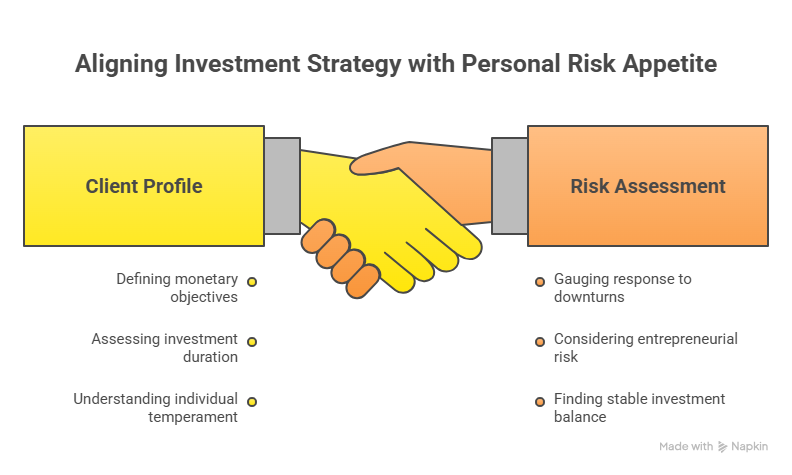
Aligning Investment Strategy with Personal Risk Appetite
Determine Your Risk Tolerance
The first step in building an investment plan is determining your risk tolerance. Roy and his team evaluate your comfort level based on your financial goals, time horizon, and personality.
If you are young with decades before retirement, you can afford more risk. If you are nearing retirement, you probably want a more conservative allocation. But risk tolerance is not just about age. It is also about who you are.
Roy has never had a job. He has always owned a business. That tells you he is a bigger risk taker than the average person. So when he sits down with someone like himself, he asks: do you want to continue taking risk on the investment side, or do you want a more conservative approach to balance out the risk you are already taking in your business?
Roy also asks people how they would feel if the market dropped 20% tomorrow. Some people light up and say they would buy more. That is a great opportunity. Other people visibly cringe. They do not see it as an opportunity. They see it as a threat.
The best return on your money is the most amount of risk you can handle without panicking and selling at the bottom. If a 20% drop causes you to call your advisor and say you want out, you are taking too much risk. The goal is to find the allocation that lets you sleep at night and stay invested through market cycles.
Diversify Your Portfolio
Once you know your risk tolerance, the next step is diversification. Diversification means spreading your money across different types of investments so when one goes down, another stays steady or goes up.
You might hold stocks, bonds, real estate, and insurance products. Within stocks, you might own large-cap growth funds, small-cap growth funds, mid-cap funds, and international funds. The goal is to spread risk across different asset classes.
Roy also looks at low-cost options. You might use professionally managed mutual funds or ETFs, which have better tax efficiency if you are investing in a non-qualified account. The key is keeping fees low so more of your return stays in your pocket.
Rebalance Periodically
Markets move, and when they do, your allocation drifts. If you start with a 60-40 stock-bond portfolio and the stock market has a big run, you might end up at 70-30 without realizing it. That is more risk than you intended to take.
Roy rebalances portfolios during annual reviews. If the market had a big run, he sells at the top to lock in gains and rebalance back to the target allocation. If the market is down, he might pull income from the bond portion or cash reserves and leave the stocks alone to recover.
Rebalancing forces you to sell high and buy low, which is exactly what you want to do. It also keeps your risk level consistent with your plan.
Focus on High-Growth Investments Early
When you are young and building wealth, Roy recommends focusing on high-growth investments like stocks. You might be 100% in the stock market because you have time on your side.
Every time the market drops, you are buying more shares at a discount through dollar-cost averaging. You buy more shares when prices are low and fewer shares when prices are high. Over time, this lowers your average cost per share and maximizes long-term growth.
Roy believes in setting a clear goal and timeline. You decide how much you want to accumulate, when you want to get there, and what rate of return you think you can achieve. Then you calculate your monthly savings target and automate it.
You can use the retirement savings goal calculator at roymatlockjr.com under Resources. It asks how much you have now, how much you need after taxes when you retire, what other income you expect from Social Security or pensions, your age, and your retirement age. It calculates your financial independence number and tells you how much you need to save each month to hit your target.
Let’s say the calculator tells you that saving $682 per month for 30 years at 9% will get you to your goal. You automate that $682 out of your paycheck or checking account, and you just automated your financial independence.
Adjust as Your Life Changes
Your investment strategy should change as you age and your life circumstances evolve. Roy adjusts allocations based on what matters most to your retirement.
Here is the question Roy asks: what is more important to your retirement — the money you have already saved, or the money you are going to save between now and retirement?
When you are young, the answer is obvious. Most of your retirement wealth will come from future contributions. So you stay aggressive with everything.
But if you are in your mid-50s with $1 million saved and you plan to contribute $20,000 per year for the next five years, the $1 million is far more important than the $100,000 you will add. That $1 million is the foundation of your retirement. If it drops 40% right before you retire, you are in serious trouble.
Roy gets more conservative with the lump sum while staying aggressive with monthly contributions. He might move the $1 million into a 60-40 stock-bond allocation to protect it, but keep the $20,000 annual contributions going into 100% growth funds. If the market drops, those contributions buy at a discount and recover when markets come back. This strategy protects what you have while still taking advantage of dollar-cost averaging with new money.
Choose the Right Tax-Advantaged Accounts
One of the most powerful tools in wealth building is using the right retirement accounts. You have two main choices: pre-tax accounts and after-tax accounts.
Pre-tax accounts include traditional 401ks, 403bs, 457s, and traditional IRAs. You get a tax deduction when you contribute, the money grows tax-deferred, and you pay taxes when you withdraw it in retirement. You also get matching funds from your employer if you participate in a workplace plan. That is free money — a 100% return right off the bat.
After-tax accounts include Roth IRAs and Roth 401ks. You pay taxes upfront, the money grows tax-free, and you never pay taxes on withdrawals in retirement.
How do you decide which one to use? Roy says it depends on your income now versus your expected income in retirement. If you are young and starting out, a Roth probably makes more sense because your income will likely be higher later. If you are a high earner now and expect lower income in retirement, the pre-tax deduction might be more valuable.
Roy also teaches a buy-one-get-one-free strategy. Let’s say you are over 50 and you max out your 401k contributions at $32,500 (including the catch-up contribution). If you are a high earner, that deduction saves you about $10,000 in taxes. You take that $10,000 tax savings and put it into a backdoor Roth IRA, contributing the maximum $8,600. Now you funded a pre-tax retirement account and a tax-free Roth IRA with the same money. You bought one and got one free.
Health savings accounts are another option. If you have a high-deductible health plan, you can contribute over $8,000 per year if married or over $4,000 if single. You get a tax deduction, the money grows tax-free, and you can withdraw it tax-free for medical expenses. After age 59.5, it works like a Roth IRA. It is one of the best tax-advantaged accounts available.
When to Take Social Security
Generally speaking, Roy tells people to take Social Security as soon as they stop working. If you are not working and you are eligible, take it. If you are still working, wait until full retirement age at 67 to avoid the earnings test.
If you wait from 67 to 70, you get about an 8% increase per year. That sounds good, but it takes about 10 years of income just to break even. And that does not account for investing the money. Roy’s advice: take Social Security and invest it if you do not need it for living expenses.
In many cases, taking Social Security allows you to put money into a tax-deductible retirement account. So you get Social Security income, you deduct the contribution, and you keep your taxable income low. There are a lot of strategies like this that save taxes and maximize wealth.
Retirement Income Strategy — Annuities and Withdrawals
When you retire, you need to shift from accumulation to distribution. Roy typically recommends a mix of guaranteed income and growth investments.
An annuity gives you lifetime income that never runs out, no matter how long you live. You can buy a joint-life annuity if you are married, so it pays as long as either of you is alive. The primary reason to buy an annuity is to offset the risk of living too long and running out of money.
Are you going to put all your money in an annuity? Absolutely not. Roy typically uses about one-third of a portfolio for guaranteed income. The rest stays invested in a diversified portfolio — maybe 75% stocks and 25% bonds — to provide growth, keep up with inflation, and leave an inheritance.
Roy shares an example. A couple has $4,400 per month in Social Security. They put $200,000 into an annuity and get $1,600 per month in guaranteed income. Now they have $6,000 per month coming in, their house is paid off, and the rest of their money is in a 75-25 stock-bond portfolio. If the market is up, they pull income from stocks and rebalance. If the market is down, they pull from bonds or cash and leave the stocks alone to recover. The guaranteed income covers their baseline expenses, and the growth portfolio handles inflation and inheritance.
This is how you avoid sequence of returns risk. If you are 100% in stocks and the market crashes right when you retire, you are forced to sell shares at a loss to maintain your income. Those shares never recover. But if you have guaranteed income and conservative buckets to pull from during down years, your stock portfolio can stay invested and come back when markets recover.
College Planning — 529s, ESAs, and Custodial Accounts
If you want to save for your kids’ education, you have several options. The most popular is a 529 plan. You contribute after-tax dollars, the money grows tax-free, and you withdraw it tax-free for qualified educational expenses. You can also move the beneficiary from one child to another if one gets a scholarship. Starting in recent years, unused 529 funds can even be converted to a Roth IRA under certain conditions.
You can also use an ESA (Education Savings Account) or custodial accounts like UTMA or UGMA. Custodial accounts give the child access to the money between ages 18 and 25, depending on the state. The money gets favorable tax treatment, and you can use it for anything — college, a car, a down payment on a house.
Roy tells the story of a client who started investing at age 16 while working at Wendy’s. Years later, at a seminar, the young man stood up and said he just put a down payment on a house with the money he saved as a teenager, and he still had $29,000 left over. That is what happens when you start young.
Roy also recommends teaching kids about investing early. He had his kids look at different mutual funds and pick which one they wanted based on the companies in the fund. One son saw GameStop and Nintendo in a fund and said he wanted that one. That is how kids learn — by seeing it, touching it, and watching their own money grow.
You can open investment accounts for kids with as little as $250. If you link a checking account, you can add money anytime. Roy did family financial workshops where he gifted $250 accounts to 27 kids in his family. He taught them how investing works, and now those kids understand compound interest before they even graduate high school.
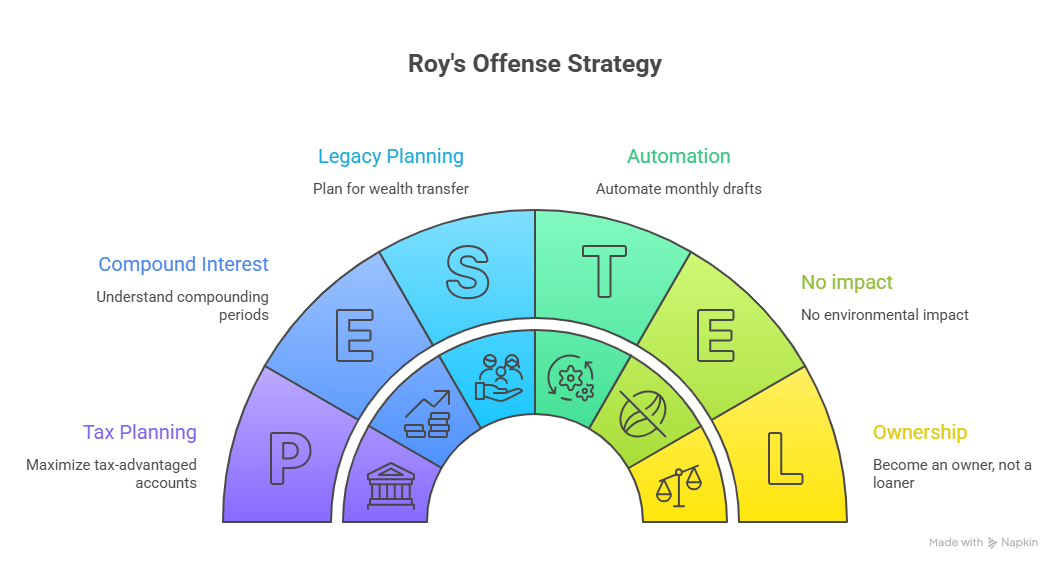
Roy’s Offense Strategy
The Key Points of the Offense
Here is Roy’s complete offense strategy in summary form.
Pay yourself first. Automate monthly drafts out of your checking account or through your employer’s retirement plan. Fifty dollars per month at 9% is about $250,000 over 40 years. One hundred dollars per month is half a million. Pay yourself before you pay anyone else.
Understand compound interest. Compounding periods matter. If you get 4% on your money, it doubles in 18 years. If you get 12%, it doubles in six years. This is called the rule of 72. Divide 72 by your rate of return, and that is how many years it takes to double your money.
Give yourself time. The best time to start is today. Not tomorrow. Not in 10 years. Now. Time is the most powerful force in wealth building, and you cannot get it back once it is gone.
Stay consistent. Automate your contributions so they happen every month whether you think about it or not. Consistency beats motivation every time.
Diversify across asset classes. Spread your money across stocks, bonds, real estate, and other investments so no single event wipes you out.
Rebalance annually. Keep your allocation in line with your risk tolerance and goals. Sell high, buy low, and stay disciplined.
Use tax planning strategies. Maximize contributions to tax-advantaged accounts. Use Roth conversions when your income is low. Make charitable contributions from your IRA to avoid paying taxes on the distribution. Use health savings accounts to save on taxes while building a medical fund.
Think about legacy and wealth transfer. Set up a living trust, healthcare and financial powers of attorney, and a living will. If you want to leave money to the next generation, plan for it now so your family does not fight over it later.
Become an owner, not a loaner. Do not just loan your money to the bank at 3%. Own the bank instead. How? Buy stock in the bank. But you do not know which bank to buy, so you hire professional money managers to do it for you. They research companies, meet with management, and invest in the best opportunities. You get the returns without doing the work.
Ready to Go on Offense?
Roy and his team are fiduciaries with access to every investment product and insurance option. They match products to your stage in life, build automated investment plans, and help you implement everything covered in this episode.
If you want help going on offense and building real wealth, reach out for a 15-minute phone call. Visit roymatlockjr.com or call 615-843-2999.
You can also use the financial calculators under Resources to figure out how much insurance you need, how much to save for retirement, and what your financial independence number is. Everything you need to build your plan is at roymatlockjr.com/resources.
Listen to the Full Podcast
This episode covers the complete offensive strategy for building wealth from the ground up. Listen to the full February 21, 2026 episode of The Roy Matlock Jr. Money and Business Hour here: PODCAST: February 21, 2026
Business Owners on the Air with Roy
Are you a successful small business owner, or maybe you know someone who is! Roy wants to interview business owners who have success stories for inspiration to our listening audience, to share their journey from starting out to success. Nominate someone you may know, or yourself, by clicking here.
